
News article
Off-plan vs. ready apartment in Dubai: which pays off more?
Off-plan offers an entry price 20–40% lower, a payment schedule that can extend beyond handover and historically the strongest capital growth. A ready apartment, by contrast, generates immediate rental income of 7–9% per year and carries no construction risk. A detailed comparison of both strategies, including a modelled IRR for a Czech investor with a 5-year horizon.
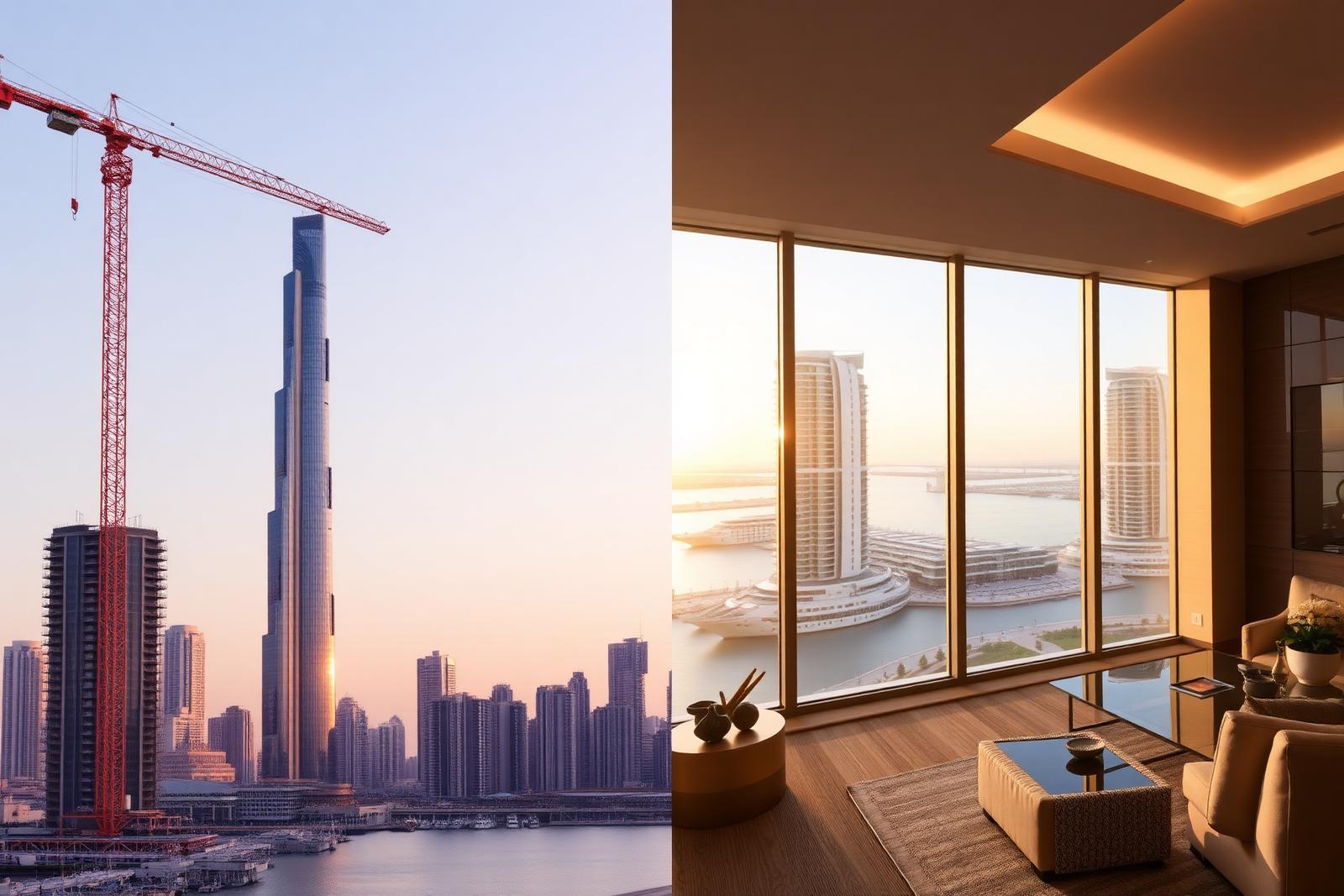
The most frequent question an investor entering the Dubai property market asks is: buy off-plan (a project under construction with staged payments) or a ready apartment with immediate income? The answer depends on the investment horizon, need for cash flow, risk tolerance and diversification strategy. The following comparison summarises both strategies from a Czech investor's perspective.
What off-plan means
Off-plan means acquiring a unit before construction is completed, directly from the developer. The investor signs a Sale & Purchase Agreement (SPA), the contract is registered in the Oqood system at the Dubai Land Department and payments are linked to construction milestones (typically 20% at reservation, 40–60% during construction, the balance at handover). Many developers today offer a Post-Handover Payment Plan — the investor pays part of the price after handover and once rental income has started.
What ready (secondary) means
A ready apartment is a completed unit bought either directly from the developer (in recently completed projects) or from a previous owner in the secondary market. The Title Deed is issued immediately, the DLD 4% fee is due at transfer and the investor can rent out the unit straight away.
Key differences (a practical view)
Entry price: for the same location and specification, off-plan is typically 20–40% below a comparable ready unit. The premium on ready units reflects the elimination of project risk and the option of immediate rental income.
Capital growth: historically, off-plan in Dubai's strong locations (Downtown, Business Bay, JVC, MBR City) has delivered higher capital growth than the ready segment over a 3–5 year horizon, as the investor captures both the gap between launch price and completion price and the natural market growth. The ready segment is more conservative and grows more slowly in periods of strong market momentum.
Cash flow: ready generates rental income effectively from transfer (7–9% gross yield in prime locations, 8–10% in JVC / Al Furjan). Off-plan generates no rent during construction — the first rent comes only after handover (typically 12–36 months after purchase).
Capital intensity: off-plan allows spreading the investment over time (payment schedule + Post-Handover) — the investor therefore does not lock up the full amount up front. Ready requires the full price at transfer (or completion via a mortgage at 50–60% LTV).
Risk: off-plan carries project risk (delay, quality changes, developer risk). This is mitigated by choosing a reputable developer (Emaar, Damac, Sobha, Deyaar, Binghatti and similar) and the RERA escrow protection. Ready carries only standard market and rental risk.
A modelled example (5-year horizon, unit at USD 400,000 equivalent)
Off-plan case: entry price USD 400,000, payments staged over time, completion after 24 months, rent starting from month 25, gross yield 8% p.a., capital growth of 25% over the period to completion + 15% over the following 3 years. Modelled IRR in the range of 15–20% p.a. (excluding financing costs).
Ready case: entry price USD 400,000 fully paid at transfer, rent from month one, gross yield 8% p.a., capital growth of 10% over 5 years. Modelled IRR in the range of 10–13% p.a.
The figures above are illustrative — actual IRR depends on the specific unit, developer, location, rental occupancy, FX moves and price developments in the Dubai market.
When to choose off-plan
• The investor has a 3+ year horizon and seeks capital growth beyond rental yield.
• The investor wants to optimise capital intensity — paying part of the price after completion.
• The investor is looking for a specific location or unit type not available in the secondary market.
When to choose ready
• The investor needs immediate cash flow (rental income from month one).
• The investor wants to eliminate project risk and hold the Title Deed immediately.
• The investor is looking for a unit with a rental history and evidenced occupancy.
A specific project in our portfolio
Fitting the off-plan strategy "premium location with strong rental potential" is Opal by Crystal in Jumeirah Village Circle — an off-plan project with a Post-Handover Payment Plan and direct exposure to one of Dubai's strongest rental districts. Current unit availability, payment schedule, layouts and floor plans are on the project detail page.
Summary
There is no single "better" strategy — off-plan and ready address different investor needs. An optimal portfolio often combines both: a ready unit for stable cash flow and one or more off-plan units for capital growth and lower capital intensity. The key is a clearly defined investment horizon and a partner who can align both strategies over time.
Risk notice
The IRR figures shown are illustrative and do not represent a guaranteed or average yield for any specific unit. Off-plan projects carry the risks of construction delay, changes to specification and developer risk. Ready units carry market and rental risk, including vacancy periods and maintenance and service-charge costs. Past performance of the Dubai market does not guarantee future results. This news item is provided for information only and does not constitute a public offer or investment recommendation.
Related project